Business
Debating the Debate Over Tipped Minimum Wage in Chicago
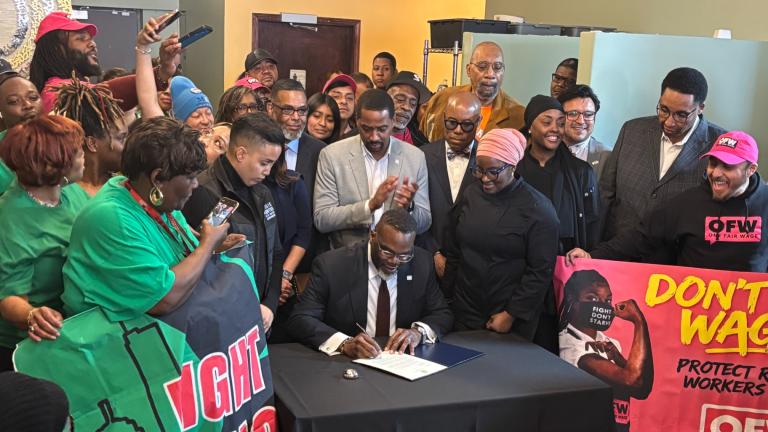
Tipped workers in Chicago are getting caught in a back-and-forth at City Hall.
Last week, the City Council reversed its own 2023 vote that would phase out the tipped minimum wage. Mayor Brandon Johnson said he’ll veto that reversal measure.
The original ordinance marked a compromise between the Illinois Restaurant Association and the mayor’s office — giving restaurants five years to prepare for the end of the tipped minimum wage in 2028, while giving workers annual 8% raises.
The goal of the original ordinance was to end the 24% tip credit afforded to restaurants. For years, this meant owners would pay their tipped service workers below the minimum wage, with the idea being that tips would make up the rest of the margin.
Supporters of keeping the lower tipped minimum wage argue tips are non-taxable income for earners making under $25,000 a year in tip revenue. They say it’s a win for restaurant owners who have seen an increase in product costs over the last few years in an unstable economy.
Though critics believe the practice is unfair and leaves workers with unlivable wages, stripping them of protections in an unstable economy. Restaurant groups say the raises have cut into their already thin margins, while others say it helps the city’s lowest-paid workers.
Those Who Support City Council Overturning
In agreement with 30 City Council members who reversed the 2023 phase out of tipped minimum wage, Sam Toia, president and CEO of the Illinois Restaurant Association, believes this reversal will alleviate the economic burden faced by Chicago restaurants.
When the measure initially passed in 2023, it was supposed to have been a compromise between his organization and the Johnson administration to give restaurants a five-year grace period. Despite the compromise, Toia was and remains against the elimination of the tip minimum wage, citing the growing costs on restaurants.
He says product costs are up 31% since 2020 due, in part, to the war in Iran and the Trump administration’s tariffs. He also says labor costs are up 35%.
“We know over 490 (restaurants) closed in the first half of 2025 here in the city of Chicago, all you have to do is look up and down our commercial streets, like 79th/53rd Street, Lincoln Avenue, Western Avenue, Lawrence and see all the empty storefronts,” Toia said. “It’s really hurting a lot of our independent restaurants here in the city of Chicago.”
Shanell Oliver, a tipped service worker at Bronzeville Winery, has been in the service industry for over 20 years.
“You don’t need a sledgehammer policy,” Oliver said. “We need surgical care when it comes to figuring out what’s going to be the best way to kind of deal with the issues at hand. This policy is going to obliterate the restaurant industry, especially in communities like Bronzeville and South Shore and under-resourced communities”
A Look at the Data
In a recent social media post, the mayor’s office posted that there has been a net gain of 1,344 food businesses since the 2023 ordinance was passed.
In the two years since the One Fair Wage ordinance has been in effect, Chicago has enjoyed a net gain of 1,344 food business licenses while the license renewal rate has jumped to 83%.
More hospitality workers were employed in Chicago in December 2025 than were in July 2024. https://t.co/JcZlPpZesw— Chicago Mayor's Press Office (@ChicagoMPO) March 16, 2026
City data provided shows that the renewal rate for restaurant licenses has risen by a small margin since the 2023 measure was passed. Toia does note the information could include gas stations and corner stores that sell snacks. cc
City officials also say there has been no sign that the pace of restaurant closures have increased, dismissing Toia’s initial concerns.
According to the U.S. Bureau of Labor Statistics, Chicago-area servers made an average of $16.76 an hour and $34,870 yearly, as of May 2024.
They also found that the lowest percentile workers were making $14 an hour, below the minimum wage even for the time, with the highest making $23 an hour.
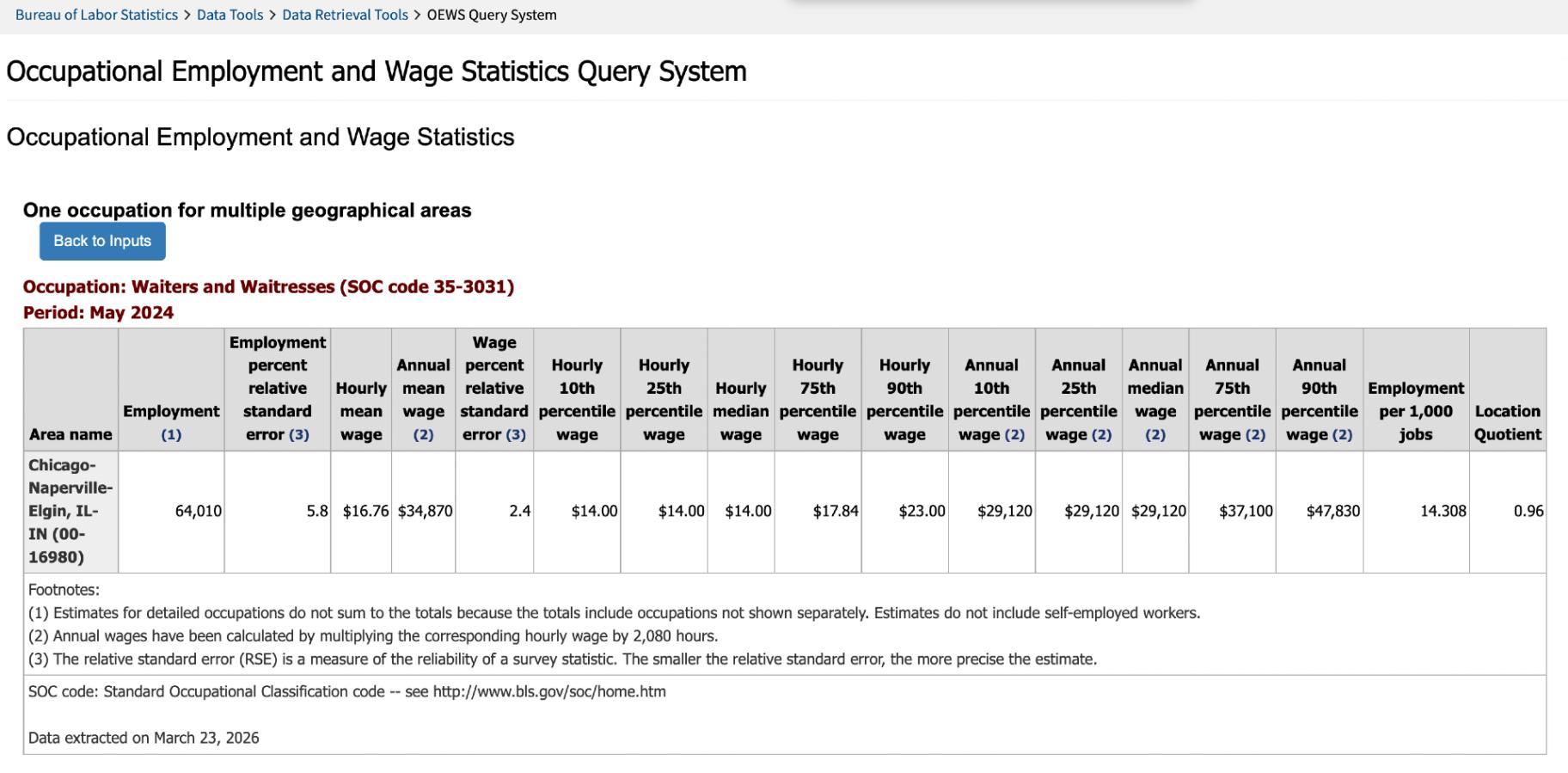 (Source: U.S. Bureau of Labor Statistics)
According to a news release from the Illinois Restaurant Association, the first half of 2025 saw 496 closures of Chicago restaurants with those remaining in business experiencing 7,800 jobs below pre-pandemic employment levels.
Though it remains unclear if this is caused by the steady elimination of the tip minimum wage.
A survey in the same release shows that 99% of the 204 restaurants the IRA surveyed were likely to increase menu items with 95% likely to cut employee hours.
The current minimum wage for tipped workers is $12.62.
Those Who Support the Mayor's Veto
Molly Pachay, a tipped worker of nearly a decade and current director of strategic partnerships with the Chicago Hospitality Accountability and Advocacy Database, believes there is a better way to meet the demands of restaurants without sacrificing workers’ pay.
Pachay says the same struggle restaurants face with costs are being felt by workers trying to buy groceries, acknowledging that it is difficult for everyone including mom-and-pop shops.
“I do not think the solution is to reach into the pockets of the worst to try and subsidize that risk of owning and operating. I don’t think it has to be either or,” Pachay said. “I think there are a lot of solutions that I wish the Illinois Restaurant Association would invest their considerable resources into exploring.”
She offered ideas like lobbying the state to reduce payroll taxes and asking the city to invest in urban farming to allow the purchase of produce and products at a lower cost.
“So this idea that it’s just because tipped workers are making $1 or $2 more every year, that’s why we’re seeing all these restaurant closures,” Pachay says. “That is not the whole story, and I’m so tired of workers always bearing the brunt of this conversation.”
Gina Laff is an organizer with the Chicago Hospitality Accountability and Advocacy Database and has been a tipped worker for the past 14 years. In that time, she recalls experiencing wage theft from the majority of restaurants she’s worked at, including during times of personal hardship.
“Usually it comes down to the brink of every cent in my paycheck matters,” Laff said. “Can I pay rent on time, or am I able to get medicine for my mother? This is a very serious matter for me, because it affects me personally, and it affects many of the people I love as well.”